Modular Electronics Enclosures for Instrumentation Allow Versatile Cooling
Ventilation & Cooling
There are a various cooling options to consider for sheet metal and aluminum enclosures: incorporating fans, partial top perforation for heat exhaust, full top perforation for higher exhaust requirements, bottom and top perforation (often for external fan trays or other cooling, and front and/or rear panel perforation in various types. We’ll leave out the more exotic other options for cooling that include liquid, conduction-hybrids, etc.
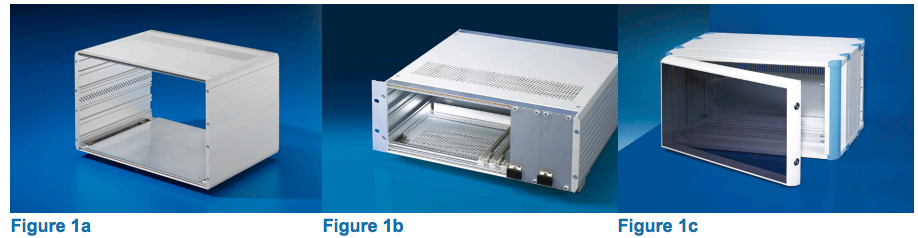
Figure 1a: Top perforated cover on an enclosure for natural convection
Figure 1b: Top and bottom airflow
Figure 1c: Perforations in the top, bottom, and rear of the instrument case. Clearly, more openings allow more heat evacuation.
 To provide standard aluminum enclosures in 1U-14U heights, widths at 19” or 9.5” or compact sizes, and depths from 250mm to over 500mm, there are a lot of configurations. Providing every one of the above cooling options is not always available standard in every size, but customization can typically be kept to an absolute minimum with a modular design. That means a standard or “modified standard” tailored enclosure solution that gets you to market quickly and keeps your development and production costs low.
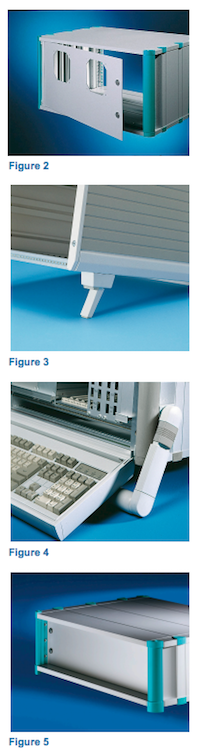
Many of today’s instruments and devices that use metal enclosures have an internal fan on a device and/or another cooling option such as using heat sinks/conduction. Of course, completely enclosed options are available too. However, placing a fan tray at the bottom of the enclosure is another common option. Alternatively, fans can be incorporated into the rear (typically) panel. Often, these are standard 120mm muffin fans, but other sizes are certainly possible. See Figure 2 for an example.
For access into the enclosure, it is common for these panels to be hinged on the side or the bottom. This allows for maintenance or replacement of parts and general access to the device.
Feet and Stands
Many desktop enclosures come with standard “feet” options. These are not just aesthetics. The feet can help angle the enclosure for easier viewing, prevent scratches on the desktop, and provide spacing between the bottom of the enclosure and the desk/surface to allow airflow (see Figure 3). The carry handle could also act as a stand to prop up the enclosure and achieve these same goals. The dual function is very convenient for devices that need to be transported often. It also provides a nice aesthetic appearance (see Figure 4).
Instead of standard feet, there are stands which help attain the same goal. These end caps also provide a stand-off and protect a desktop or lab bench from direct contact from the metal case. The enclosure in Figure 5 shows how a clever design allows multiple enclosures to be stacked. The top of the enclosure has a shape on the edge of the bezel that allows a similar enclosure placed above it to securely fit.
Front and Rear Panel Types
Electronics enclosures have various front panel types. Often, a blank panel will have customized cutouts for the OEMs application. In some applications, front-pluggable modules will be utilized. So, the panel will be enclosed by the pluggable boards and optional filler panels to enclose unused slots.
As shown earlier in Figure 2, the panels can standardly allow air convection from the front or rear of the enclosure (or both). At times, there are front-pluggable modules in instrumentation cases. There are also ways to have front air access below these modules as shown in Figure 6.
recessed area. This figure also illustrates that the instrument cases don’t need to be 19” width (the most standard size for rack-mounting an enclosure). Enclosures that are smaller are a standard option as well, with the ½ of 19” (9.5” size) being very common.
A “Custom” Design Using Standard Components
Modular instrument cases and enclosures provide a wealth of cooling options for virtually unlimited configurations. Whether an enclosure needs perforations in the front/rear or top/bottom or even the sides, there are standard options available in the marketplace. A design engineer can essentially have a customized enclosure utilizing standard components. With modular cases, you can truly “cool it your way.”