
Feeding the Beast: Scaling Data Center Infrastructure Capacity To Plan for Production AI
August 13, 2026
When Theory Meets Reality
In 2025, Gartner predicted that by the end of the year, one-third of AI projects would not progress beyond the proof-of-concept phase. As we navigate 2026, that prediction has largely proved accurate. The gap between prototype success and production deployment is not primarily a technical capability—it is infrastructure capacity planning that separates winners from casualties.
Hyperscalers are spending more than $600 billion in 2026 on AI infrastructure expansion, yet even with this unprecedented investment, more than 36 projects worth $162 billion have been blocked or significantly delayed due to power availability, equipment lead times, and local opposition. The message is clear: building AI infrastructure at scale requires fundamentally different planning approaches from traditional data center deployments.
The challenge is not simply buying more GPUs. It is recognizing that GPU-accelerated infrastructure requires only 1/40th the physical footprint and 1/20th the power of CPU-only data centers for equivalent AI workload performance. Yet paradoxically, these “efficiency gains” translate to rack densities of 30–200 kilowatts, compared with traditional 8–12 kilowatt racks—creating thermal, electrical, and operational challenges that demand entirely new planning frameworks.

Workload Analysis: The Foundation of Capacity Planning
Understanding Memory Requirements
Parameter count, precision, batch size, and context length determine GPU memory demands—often the true limiting factor in AI deployment. A 70-billion-parameter model running in FP16 precision requires approximately 140 GB of GPU memory just to load the model, before accounting for activation memory during inference or gradient storage during training.
The mathematics are unforgiving. Each parameter consumes 2 bytes in FP16 or 4 bytes in FP32 precision. Activations during forward passes can require 2–3x the model size in additional memory. Training requires storing gradients and optimizer states, potentially requiring 4–6x the base model memory. These multipliers determine whether workloads fit on available hardware or require expensive distributed configurations.

Context window length creates additional pressure. Transformer models’ memory requirements scale quadratically with sequence length. A model handling 32,000-token contexts consumes 16x more activation memory than one handling 8,000 tokens. Long-context applications such as document analysis or video understanding push memory requirements beyond single-GPU capabilities, forcing multi-GPU configurations even for inference workloads.
Assessing Scaling Behavior
Some models scale nearly linearly across many GPUs; others plateau quickly. Understanding scaling efficiency prevents overprovisioning and informs networking architecture requirements. A model achieving 90% scaling efficiency on 8 GPUs might drop to 60% efficiency on 32 GPUs and 40% efficiency on 128 GPUs as communication overhead comes to dominate computation.
Testing at target scale matters. A prototype running efficiently on 4 GPUs might encounter unexpected bottlenecks at 64 GPUs. Network topology, memory bandwidth, and synchronization patterns that work at small scale often fail at production scale. The only reliable capacity planning approach involves benchmarking at representative scales before committing to large deployments.
Horizontal scaling has emerged as the dominant strategy for 2026, replacing vertical scaling approaches that attempt to maximize utilization of massive GPU clusters. Kubernetes-based orchestration using Horizontal Pod Autoscaler (HPA) and Vertical Pod Autoscaler (VPA) treats compute as a distributed resource that can be intelligently allocated rather than a monolithic asset that must be maximally utilized at all times.
Identifying Workload Types
Training, fine-tuning, and inference workloads have fundamentally different infrastructure demands. Training emphasizes throughput and can tolerate latency, often running in batch mode overnight or across multi-day periods. Inference requires low latency and cost efficiency, frequently using earlier GPU generations that balance performance against operational costs.

The workload mix determines infrastructure composition. An organization spending 70% of compute time on inference and 30% on training should not provision 50/50 infrastructure. Instead, capacity planning should reflect actual utilization patterns, potentially using older GPUs for inference, reserving latest-generation hardware for training, and implementing workload-aware scheduling that routes jobs to appropriate hardware.
Sourcing Strategies: Build, Buy, or Blend
On-Premises Clusters
Owning hardware delivers predictable economics, eliminates egress fees, and gives teams full control over performance tuning. This approach works best for organizations with steady, high-volume workloads and internal capabilities to manage distributed systems.
The capital expenditure can be daunting. An 8-GPU NVIDIA H100 system costs $250,000–$300,000. A 64-GPU training cluster represents $2–$2.5 million in hardware alone, before accounting for networking, storage, power distribution, cooling infrastructure, and physical space. These costs require multi-year amortization, locking organizations into hardware decisions that may become obsolete as GPU generations advance.
However, for sustained workloads, ownership economics often favor on-premises deployment. AWS charges approximately $30–$40 per GPU hour for H100 instances. Running continuously, a single H100 costs $260,000–$350,000 annually in cloud fees—matching or exceeding purchase cost within 12–18 months. Organizations with consistent GPU utilization of 50% or higher typically achieve better total cost of ownership through ownership rather than renting.
Cloud Flexibility
Major cloud providers offer immediate GPU availability without capital expenditure, supporting burst capacity for variable workloads and providing access to the latest hardware without procurement cycles. This model excels for organizations with unpredictable demand, development teams requiring rapid experimentation, and workloads requiring geographic distribution.
The flexibility comes at a premium. Cloud GPU pricing includes provider margins, facility costs, and operational overhead. For inference workloads with high variability, however, the ability to scale from zero to hundreds of GPUs within minutes and scale back down during quiet periods delivers cost advantages that on-premises infrastructure cannot match.
Multicloud strategies have become standard practice by 2026. Rather than committing exclusively to one provider, organizations blend on-premises baseline capacity with multicloud burst capacity, accessing best-in-class GPUs across providers, avoiding single-provider dependency, and optimizing costs by selecting providers based on workload characteristics and regional pricing.
Hybrid and Specialty Providers
Many organizations adopt a blended model: on-premises for baseline workloads, cloud for bursts, and specialized providers for GPU-dense clusters that exceed cloud configurations. This strategy maximizes flexibility and performance without overcommitting resources.
Specialty providers like CoreWeave, Lambda Labs, and regional providers offer configurations optimized specifically for AI workloads, often with better price-performance than hyperscaler general-purpose infrastructure. These providers focus exclusively on GPU computing, delivering optimized networking, storage, and orchestration that hyperscalers treat as general-purpose capabilities.
The emerging GPU-as-a-Service model provides middle-ground economics. Rather than owning hardware or paying hourly cloud rates, organizations commit to reserved capacity at significant discounts compared to on-demand pricing while maintaining flexibility to adjust allocations quarterly rather than across multi-year hardware lifecycles.
Power and Cooling: The Hidden Constraints
High-Density Power Requirements
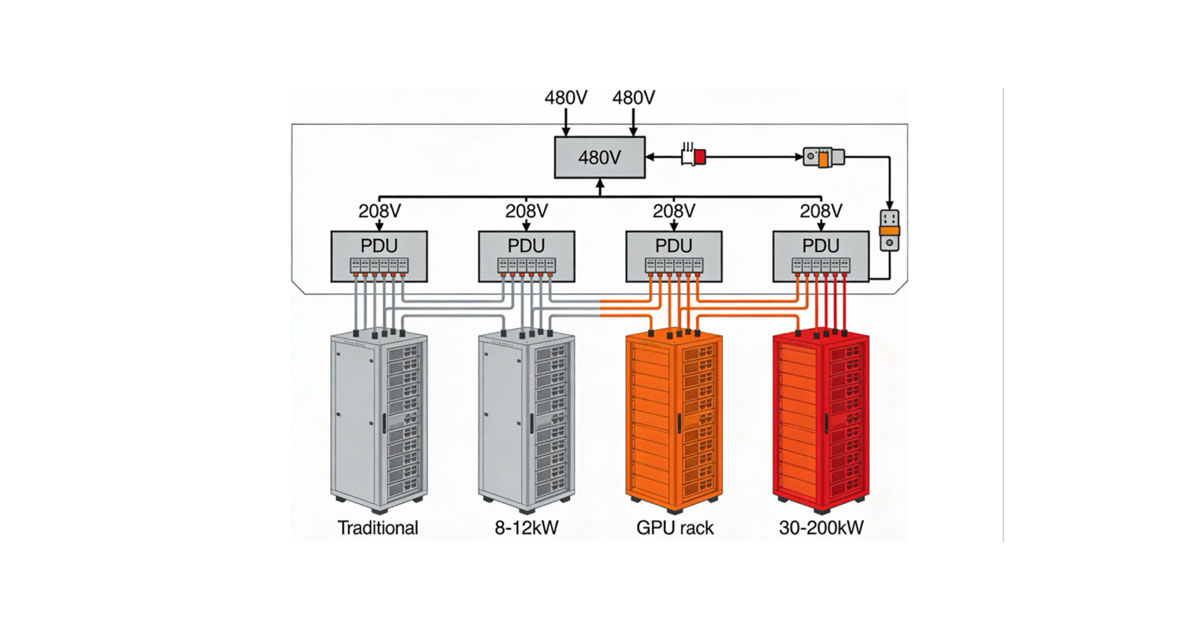
GPU racks consuming 30–200 kilowatts dwarf traditional 8–12 kilowatt configurations. An NVIDIA H100 GPU consumes 700 watts at peak utilization. An 8-GPU server draws 5.6 kilowatts for GPUs alone, plus CPU, memory, networking, and storage overhead, reaching 6–8 kilowatts per server. A 42U rack holding 5–6 such servers approaches 40 kilowatts—quintupling traditional rack power.
This density requires rethinking electrical distribution. Traditional data centers distribute 480V three-phase power to rows, stepping down to 208V at rack PDUs. High-density GPU racks increasingly use direct 480V distribution to minimize transmission losses, requiring different cabling, connectors, and safety procedures than traditional infrastructure.

Power provisioning has become the primary constraint on AI infrastructure deployment. Cudo Compute reports that its purpose-built AI facilities support racks up to 200 kilowatts, with hundreds of megawatts available today scaling to gigawatt capacity as demand grows. These figures would have seemed absurd for data center planning five years ago—they are now minimum requirements for frontier AI deployments.
Advanced Cooling Solutions
Air cooling approaches its physical limits above 30–40 kilowatts per rack. Moving sufficient air volume to dissipate 50+ kilowatts creates noise, requires massive HVAC infrastructure, and wastes significant energy.
Liquid cooling has transitioned from exotic experiment to operational necessity. By 2026, liquid cooling is expected to drive 55% of hyperscale AI data center deployments. The technology offers multiple implementation approaches, each with distinct characteristics.
Direct-to-chip liquid cooling uses cold plates mounted on GPUs, CPUs, and memory, circulating coolant through closed loops. This approach removes 70–80% of system heat directly to liquid, significantly reducing air cooling requirements. Retrofitting existing racks is relatively straightforward, and the technology achieves 20–30% energy savings compared to air cooling alone.
Single-phase immersion cooling submerges servers completely in dielectric fluid. Heat transfers directly from components to fluid without air as an intermediary, enabling rack densities exceeding 100 kilowatts. The fluid circulates to heat exchangers where cooling water or other secondary coolants remove heat. Implementation requires redesigned servers and specialized tanks, but operational energy can be reduced by 30–45% compared to traditional air cooling.
Two-phase immersion cooling represents the efficiency frontier. Dielectric fluid boils at temperatures slightly above component operating temperatures, absorbing heat through phase change—the most thermally efficient heat transfer mechanism available. Vapor rises, condenses on cooling coils, and returns to liquid state. This passive process removes heat without pumps, achieving PUE (power usage effectiveness) values approaching 1.1 compared to 1.4–1.8 for traditional air-cooled facilities.
The transition brings challenges. Liquid cooling requires different maintenance procedures, specialized technicians, and careful attention to fluid selection, leak prevention, and component compatibility. However, these operational adjustments are minor compared to the energy savings and density advantages that make liquid cooling indispensable for high-density AI infrastructure.
Capacity Planning Methodologies
Right-Sizing GPU Resources
Matching workload requirements to hardware capabilities prevents both underprovisioning that limits performance and overprovisioning that wastes capital. An inference workload that runs comfortably on NVIDIA T4 or L4 GPUs does not require H100s. A training workload requiring H100 performance will not succeed on A100s regardless of quantity.
The selection process begins with memory requirements. Does the workload fit in 24 GB (RTX 4090, A5000), 48 GB (L40S, A6000), 80 GB (A100, H100), or require multi-GPU configurations? Memory capacity determines the feasible hardware pool before considering compute performance.

Next, evaluate compute requirements. Training large language models benefits from tensor core performance and FP16/BF16 capability. Inference workloads often achieve better economics with INT8 quantization. Computer vision workloads emphasize different operations than natural language processing. Matching workload characteristics to GPU architecture capabilities determines price-performance outcomes.
Autoscaling and Resource Optimization
Autoscaling ensures compute resources automatically adjust based on actual demand, minimizing both overprovisioning and underutilization. Kubernetes offers Horizontal Pod Autoscaler (HPA) to scale pod counts based on CPU utilization or custom metrics, and Cluster Autoscaler to add or remove nodes as needed.
Implementation requires defining scaling metrics beyond simple CPU utilization. GPU utilization, memory pressure, request queue depth, and inference latency provide better signals for AI workloads than traditional metrics. A GPU showing 60% utilization might be memory-bound, unable to accept additional workload despite apparent headroom.
Continuous monitoring and adjustment are essential. Workload patterns shift as applications evolve, traffic patterns change, and model architectures update. Capacity planning is not a one-time exercise but an ongoing process of measurement, analysis, and refinement aligned with actual operational patterns.
Multi-Tenancy and Resource Isolation
Sharing GPU infrastructure across multiple teams and workloads maximizes utilization but requires careful management to prevent performance interference. Quotas ensure teams receive fair resource allocation without monopolizing infrastructure. Containerization provides process isolation. Quality-of-service (QoS) policies prioritize critical workloads during resource contention.
The challenges intensify with GPU sharing. Unlike CPUs, where time-slicing provides natural isolation, GPUs executing long-running kernels can block other workloads for extended periods. MIG (Multi-Instance GPU) technology on NVIDIA A100 and H100 GPUs provides hardware-level partitioning but with reduced flexibility compared to full GPU allocation.
Effective multi-tenancy balances utilization efficiency against predictable performance. Production inference workloads may require dedicated GPU allocation to guarantee latency targets. Development and experimentation workloads might accept best-effort scheduling on shared resources, tolerating occasional delays in exchange for lower costs.
Operational Challenges at Scale
GPU Scarcity and Procurement
High-performance GPUs remain expensive and difficult to obtain. Lead times for NVIDIA H100 and H200 GPUs stretched to 6–12 months during 2025, with similar constraints expected through 2026. DIY teams struggle with availability and usage optimization across different applications and traffic patterns, while managed platforms secure capacity upfront through volume commitments and provider relationships.
The scarcity creates strategic constraints. Organizations cannot simply decide to deploy AI infrastructure and expect immediate GPU availability. Capacity planning must account for procurement timelines, budget for alternatives when preferred hardware is unavailable, and maintain relationships with multiple suppliers to improve allocation access.
Scaling Bottlenecks
What works for prototypes often collapses in production. A model training efficiently on 8 GPUs encounters network bottlenecks at 64 GPUs. Inference systems handling 100 requests per second fail at 10,000 requests per second due to database contention, load balancer limits, or storage I/O saturation.
Benchmarking at production scale is nonnegotiable. Tinder’s experience benchmarking Predibase’s managed serving platform versus open-source vLLM revealed 2x throughput improvements and dramatic cost reductions—differences invisible at small scale. The investment in representative-scale testing prevents expensive production failures.
Maintenance and Operational Overhead
DIY platforms force teams into an 80/20 split—spending most of their time babysitting infrastructure instead of building valuable AI applications. Engineering teams drown in maintenance addressing hardware failures, software updates, security patches, performance optimization, and capacity management instead of innovating on core products.
Managed platforms can reduce this burden dramatically, but at the cost of reduced control and vendor dependency. The choice between building and buying infrastructure reflects organizational priorities: control and customization versus operational efficiency and time-to-market.
Cost Optimization Strategies
Continuous Capacity Reviews
Regular capacity reviews highlight underused resources, enabling reallocation or deprovisioning. A GPU cluster utilized at 40% represents wasted capital that could be redeployed or returned to cloud providers to reduce costs.
Effective reviews examine utilization patterns across time periods—daily, weekly, and monthly cycles. Weekend utilization might be dramatically lower than weekdays. Overnight training jobs might leave GPUs idle during business hours when inference demand peaks. Identifying these patterns enables better resource scheduling and consolidation of workloads onto fewer resources.
Implementation of Spot Instances and Reserved Capacity
Cloud providers offer significant discounts for interruptible “spot” instances and committed “reserved” capacity. Spot instances can reduce costs by 60–80% compared to on-demand pricing but may be reclaimed with minimal notice when capacity is needed elsewhere.
Training workloads with robust checkpointing can tolerate interruptions, making spot instances attractive. Inference workloads requiring guaranteed availability should use reserved capacity, committing to 1–3 year terms for 30–50% discounts compared to on-demand pricing.
Energy Efficiency Improvements
Power consumption represents a significant ongoing cost, especially for owned infrastructure. Improving PUE through better cooling, waste heat recovery, and infrastructure optimization directly reduces operational expenses.
Liquid cooling delivers immediate energy savings. Facilities retrofitting from air to liquid cooling report a 20–30% reduction in total energy consumption. For large deployments, these savings justify liquid cooling investments within 18–24 months purely through reduced electricity costs, before considering density or performance advantages.
Looking Ahead
Capacity planning for AI infrastructure in 2026 has shifted from accumulating maximum GPU counts to building inference-native architectures that prioritize efficiency and intelligent orchestration. The bottleneck has moved from compute availability to power delivery, latency optimization, and intelligent orchestration.
Success requires treating infrastructure as a continuously optimized system rather than a fixed resource. Organizations that recognize this shift and build capacity planning processes around efficiency, flexibility, and operational intelligence will achieve better results with less hardware than competitors still chasing the “infinite compute” dream.
Conclusion
Scaling AI infrastructure from prototype to production demands fundamentally different capacity planning approaches than traditional data center deployments. The organizations succeeding in 2026 are those that understood early that GPU scarcity, power constraints, and operational complexity require sophisticated planning processes, not just larger budgets.
Effective capacity planning balances hardware capability against workload requirements, blends ownership and rental to optimize economics and flexibility, implements advanced cooling to enable high-density deployments, and maintains operational discipline to maximize utilization and minimize waste. The winners will be those who master these disciplines while competitors struggle with procurement delays, power limitations, and unexpected scaling failures.
